Vetting Stucco Contractor References: 8 Questions to Ask Previous Clients
You found a dark stain on your stucco that will not wash off, or a soft spot near a window that gives when you press it. You called around, got a few bids, and now you are down to the last step before you sign: vetting stucco references. This step matters more than the estimate itself, because a reference call is the only place you hear from someone who already lived through the job. In Castle Rock, where bids can come from national franchise call centers, rotating crews, and thin lead-gen sites that rank well but say nothing, talking to past clients is how you find out who actually shows up and knows the material.
Here is the candid part. A franchise call center can sound polished on the phone and still send a different crew every time. A lead-gen site can rank for "stucco repair near me" and simply sell your name to whoever pays for it. Additionally, a dedicated local operation has one crew, one reputation, and past clients within a short drive of your house. References expose the difference fast, but only if you ask the right questions. Below are eight of them, in the order worth asking.
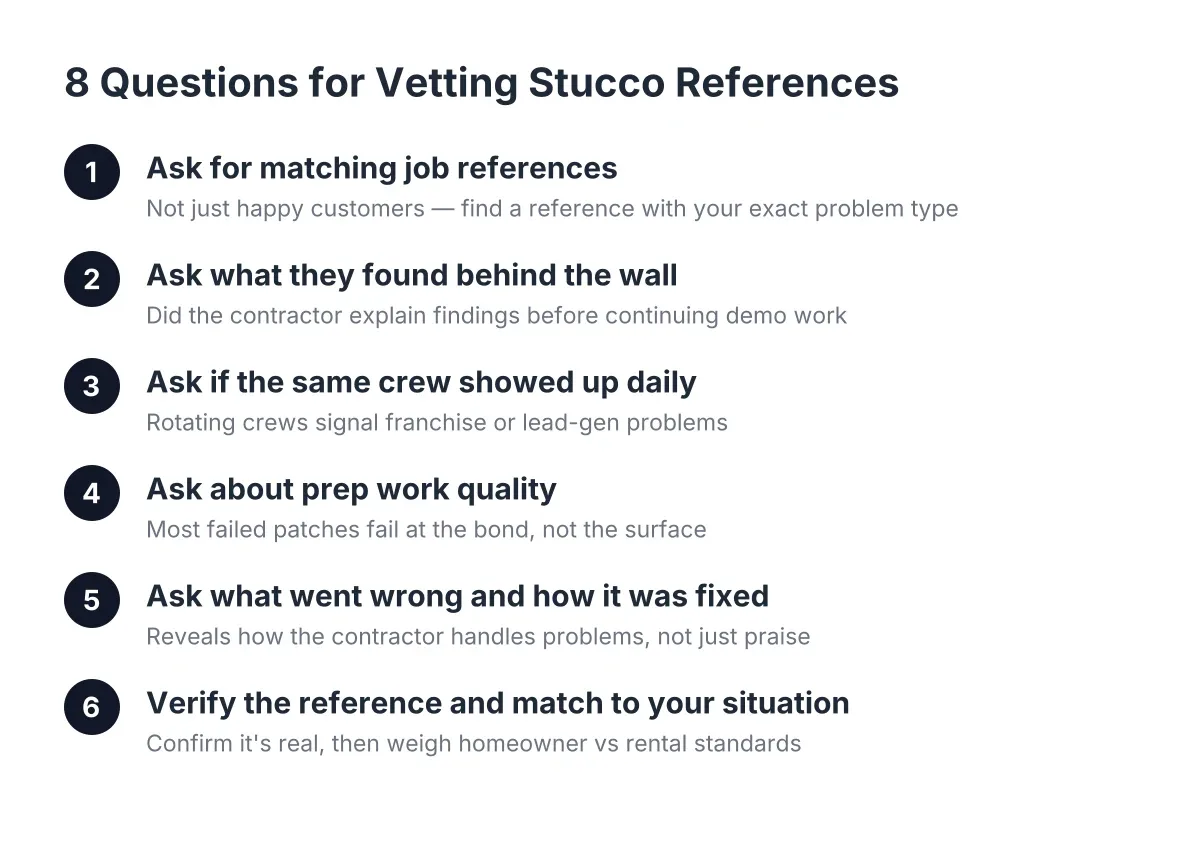
1. Ask for References From Jobs Like Yours, Not Just Happy Customers
Every contractor can produce three happy customers. What you want is a reference whose job matched yours: stucco water damage repair near a window, a soft spot traced back to a bad downspout, or a crack repair on a wall that had failed once before. If your problem is a spreading stain and crumbly stucco, a reference from a simple cosmetic patch tells you little.
Ask the contractor directly: "Can you give me a reference from a water damage repair, not just a patch job?" A stucco specialist in Castle Rock should have several. A general painter or handyman who treats stucco siding as a side service usually cannot, and that gap is your first real signal.
2. Ask the Reference What the Contractor Found When They Opened the Wall
Water damage jobs have a before and an after that the bid cannot predict. So ask the past client: "Did the contractor explain what they found behind the stucco before they kept going, or did they just start demo?" You want to hear that the crew tapped the wall, listened for hollow spots, opened a small area first, and then walked the homeowner through what the moisture had reached.
This question matters because the biggest fear with water damage is the repair ballooning once the wall is open. A trustworthy contractor pauses at that point and explains the options. A reference who says "they told me exactly what they found and what it would add before doing more work" is telling you how your own job will go.
3. Ask Whether the Same Crew Showed Up Every Day
This is where the franchise model versus local model difference becomes concrete. Ask the reference: "Was it the same people on site each day, and did the person who gave the estimate ever come back?" Rotating crews are common with national operations, and on stucco work that creates real problems; the person who mixed the first coat knows things the person applying the finish coat does not.
Local stucco companies with one steady crew keep that knowledge on the job from scratch coat to final texture. If a reference mentions new faces every visit, or a bidder who vanished after the contract was signed, treat that as a pattern, not bad luck.
How to Vet Stucco Contractor References for Texture Matching Quality
Texture matching is hand work. The person who studies your existing finish, tests a sample panel, and adjusts the mix needs to be the same person who applies the final coat. Ask the reference whether the patched area blends in now, a year or more later, or whether there is a visible square where the repair sits. For a landlord prepping a Castle Rock or Lone Tree rental between tenants, a visible patch may be acceptable; for your own home, it usually is not. Either way, you should know which result this contractor delivers.
4. Ask How the Contractor Handled Prep, Because Prep Is Where Repairs Fail
Most failed stucco patches fail at the bond, not the surface. New material will not stick to dust, loose debris, or a dried-out substrate. A good reference question sounds like this: "Did the crew spend real time cleaning and prepping before they applied anything, or did they go straight to mudding?"
Signs of proper prep that a past client might remember:
- The crew scraped off loose burrs and rough spots before coating over old stucco
- They vacuumed or brushed dust out of the repair area instead of patching over it
- They wetted the wall down before applying new material
- On larger voids, they screeded the patch flat before texturing
- They left torn lath exposed at the edges rather than grinding a clean square, so the patch could be weatherproofed into the surrounding wall
A homeowner will not know all these terms, and that is fine. Ask instead: "Did the repair hold up through a full freeze-thaw winter?" In Castle Rock, one winter tells the truth about prep work.
5. Ask What Went Wrong, and How the Contractor Responded
Something goes sideways on most exterior jobs: weather delays, a hidden second leak, a color coat that needed a second pass. The useful question is not "were you happy?" It is "what was the worst moment of the project, and what did they do about it?"
For example, suppose a past client in Castle Rock says the first texture pass did not match and the crew came back the next week and redid it at no charge. That answer is worth more than ten five-star reviews, because it shows how the contractor behaves when the job stops being easy. A reference who hesitates, or says the contractor stopped answering calls after the final check, has told you everything.
6. Ask About Communication and Reachability, Not Just Workmanship
Hiring a stucco contractor is partly hiring a phone number. Ask the reference: "When you called with a question mid-project, who answered, and how long did it take?" With a national operation, calls often route through a call center in another state, and messages get relayed to a crew the dispatcher has never met. With a genuinely local outfit, you usually reach the person doing the work.
This matters most on water damage repairs, where decisions come up mid-job. If the crew opens the wall and finds the moisture reached the sheathing, you need a call that day, with photos and plain options, not a ticket number. Vetting stucco references is the only way to confirm a company communicates that way before you are the one waiting on the callback.
7. Verify the Reference Is Real Before You Weigh the Answers
Fake or cherry-picked references exist, and the hail-repair economy along the Front Range has trained some operators to work fast and loose. Colorado has seen the pressure: hail-related questionable claim submissions rose 34% nationally between 2018 and 2020 while actual claims rose only 2%, according to the Rocky Mountain Insurance Information Association. Storm-chasing outfits that follow that money do exterior work too, and some bid on stucco.
Simple checks keep you grounded:
- Ask for the address, and drive by if the home is in Castle Rock or nearby. Look at the wall yourself from the street.
- Match the reference's description of the job to what the contractor told you. If the stories differ, ask why.
- Prefer references from a year or more ago. A patch looks fine the week it cures; the test is the following spring.
- Be wary if every reference answers on the first ring and sounds rehearsed. Real homeowners are busy and a little vague on dates.
One trade-off worth naming: the newest local stucco companies may have a short reference list through no fault of their own. A thin list is not automatically a red flag if the work you can see checks out, but it does mean the other vetting steps carry more weight.
Red Flags in Vetting Stucco References
- The contractor refuses to provide references at all, or offers only online reviews
- Every reference is from outside the area, with nothing local you can drive past
- References describe a different company name than the one on your bid
- Past clients mention a big deposit demanded before any work started
- The reference cannot recall the crew lead's name because the faces kept changing
8. Match the Reference to Your Situation: Homeowner Standards vs. Rental Timelines
Not every job needs the same contractor, and references help you sort fit. Say you own a duplex in Parker and the move-out inspection turned up cracked stucco siding and a water stain under a window, with two weeks before the next lease starts. In that scenario, ask references about schedule: "Did they start when they said, and finish when they said?" A repair that is solid and weathertight, with texture matching that is close rather than perfect, may serve a rental fine.
On the other hand, if this is your own home and the repair sits next to your front door, ask references about blend quality and whether the contractor stood behind callbacks. The same questions apply whether you are searching for an EIFS contractor in Castle Rock or stucco installers in Lone Tree, CO; synthetic and traditional stucco fail differently, so confirm the reference's wall used the same system as yours.
What Vetting References Cannot Tell You
References are the strongest single check, but they have limits. A past client cannot tell you whether the moisture behind your wall has reached framing, whether there is mold, or whether your stucco is detaching from the substrate in areas that sound hollow when tapped. Those questions need eyes on your specific wall, and if you suspect active water damage or smell mustiness inside near an exterior wall, bring in a professional assessment before the problem spreads rather than waiting for the perfect contractor search.
Treat vetting stucco references as the last gate, not the whole process. Check the estimate line by line, look at past work you can actually see, and then make the calls. Fifteen minutes on the phone with two or three past clients in Castle Rock will tell you more than any website, franchise sales pitch, or ranking page ever will. The contractor who hands over real references without flinching is usually the one whose work can take the scrutiny.
If you need stucco repair, Castle Rock Stucco Pros can help.
Prefer to talk it through? Call (720) 797-8506 — a quick call is usually the fastest way to get a straight answer for your situation.