
New Construction Stucco and Siding — Complete Guide
New construction stucco and siding decisions shape a home's exterior performance for decades, and they shape a builder's schedule for months. Whether you manage a subdivision of production homes or a single custom build, every stucco wall your crew hangs needs to meet spec, match the neighboring elevations, and cure on time. This guide covers material choices, realistic cost expectations, and what separates a reliable stucco subcontractor from one who leaves you chasing callbacks. You will also find links to detailed articles on pricing, durability, and repair standards so you can dig deeper where you need to. Read on if you want fewer punch list surprises and a cladding partner who understands both the material and the schedule.
What You'll Find in This Guide
- Water Damage in Stucco Walls: How Moisture Gets Behind and What Fails First
- How Stucco Walls Hold Up to Colorado Weather: Real Durability Expectations
- New Construction Stucco and Siding Terms Explained: A Plain-English Glossary
- Stucco Mix Ratios and Ingredients: What's Actually in a Professional Patch
- New Stucco Installation vs. Repair: When to Replace Entire Walls
- Stucco Installation Cost Per Square Foot in Castle Rock: A Full Pricing Breakdown
- How Much Does New Construction Stucco and Siding Cost?
- Rapidset Stucco Patch Kits vs. Pro Repair: Texture Match and Longevity in Castle Rock, CO
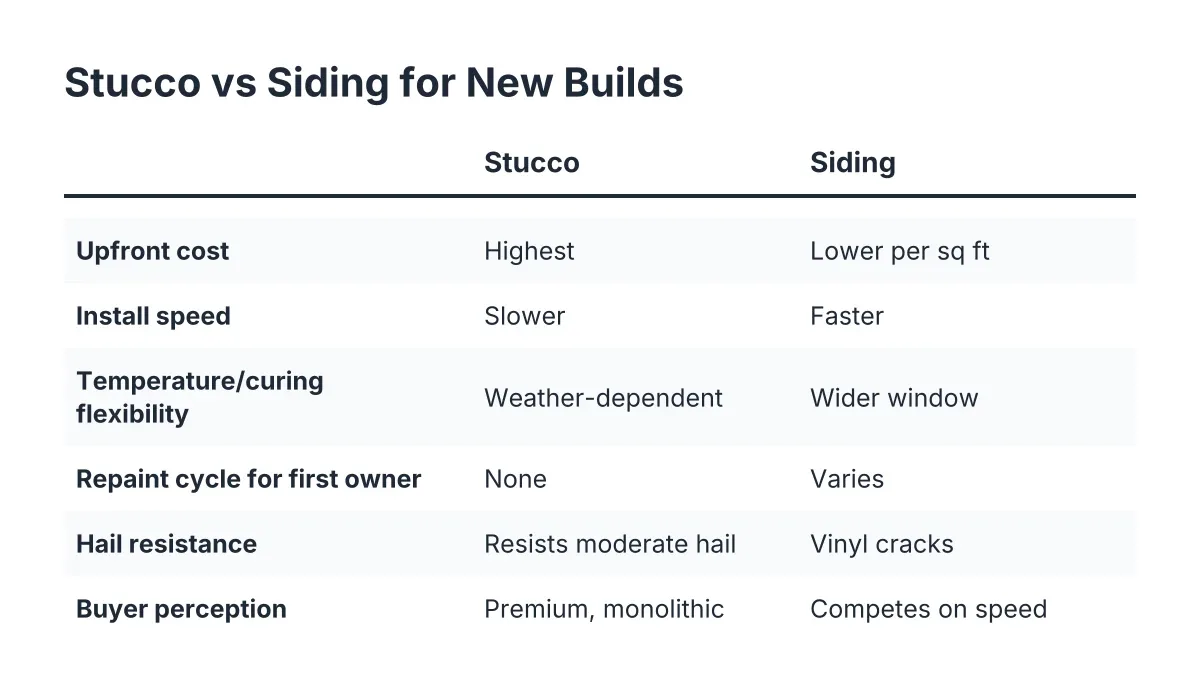
Stucco vs. Siding for New Builds: Choosing the Right Cladding
Every new build starts with a cladding decision that drives cost, schedule, and long-term maintenance. Stucco offers a monolithic, fire-resistant exterior suited to Colorado's architecture and withstands wind and sun. Siding—whether fiber cement, engineered wood, or vinyl—installs faster with smaller specialized crews. The right choice depends on your buyer profile, elevation designs, and build timeline.
For production builders, consistency and sub reliability matter more than any single material advantage. If your subdivision mixes stucco and siding elevations, both crews must maintain the same schedule cadence. A stucco crew falling two weeks behind delays paint, gutters, and final grade on every lot after it.
Material performance in this climate requires honest evaluation. Castle Rock sits in one of the nation's most hail-active corridors. Colorado logged 182,591 hail insurance claims from 2013 to 2015, the second-highest total in the nation, according to the Rocky Mountain Insurance Information Association. This exposure shapes how buyers view exterior materials and affects warranty calls three years after closing. For grounded durability insights, see our article on real durability expectations for stucco in Colorado weather.
Communication during spec and bid phases prevents costly disputes. Scope documents for lath, scratch coat, brown coat, and finish coat use terminology that trips up experienced supers when disagreements arise. We built a plain-English glossary of stucco and siding terms you can distribute to your team. Clear vocabulary up front prevents change orders later.
The builders achieving the best outcomes spec precisely, choose materials for the climate, and vet crews as carefully as products.
Stucco Wall Costs and Pricing Expectations
Cost per square foot is the number every builder chases first, and for good reason. It lets you compare bids, model margins across a floor plan series, and catch a lowball number before it becomes a job site problem. However, a single per-foot figure hides a lot. Wall height, corner count, foam trim details, scaffolding needs, and finish texture all move the number. Two bids that look identical on paper can differ by thousands once you account for what each one actually includes.
Start with our full pricing breakdown for stucco installation cost per square foot in Castle Rock to see how local labor and material costs stack up. Then, for a wider view that includes siding options and whole-house numbers, the guide on how much new construction stucco and siding costs walks through the three variables that drive total exterior spend on a new build.
Why the Cheapest Stucco Wall Bid Costs the Most Over Time
A stucco wall built to spec costs more up front than one built to hit a number. The difference shows up in the mix, the lath attachment, the flashing details, and the cure time between coats. For example, a crew that rushes the brown coat to hit a Friday deadline hands you hairline cracking within the first freeze-thaw season. Those cracks become warranty claims, and warranty claims cost more than the original savings.
Insurance pressure raises the stakes further. Colorado home insurance premiums rose 65% over the last five years, with hail cited as a major driver, according to the National Association of Insurance Commissioners. Buyers feel that pressure, and they scrutinize exterior quality more than they used to. Consequently, a builder known for exteriors that survive the first big storm without claims has a real marketing advantage. Budget for quality on the cladding line item. It is one of the few places where the cheapest bid reliably becomes the most expensive decision.
Subcontractor Reliability: What Builders Should Demand from a Stucco Crew
Schedule reliability separates a sub you use once from a partner you take across a whole subdivision. Stucco is a multi-coat, cure-dependent scope, so a crew that manages weather windows and coat timing well protects every trade behind them. Conversely, a crew that no-shows or stretches cure times without communicating turns your build schedule into guesswork. When you vet a stucco sub, ask about crew continuity, daily communication, and how they handle a weather delay mid-lot. The answers tell you more than the bid number does.
Quality consistency matters just as much as showing up. On a production run, elevation twelve needs to match elevation one in texture, color, and finish depth. That consistency starts in the bucket. Mix proportions, sand gradation, and water content determine whether a finish coat cures uniform or blotchy. Our breakdown of stucco mix ratios and what goes into a professional application shows why crews that freelance their proportions produce walls that age unevenly.
Moisture Management Is the Real Quality Test
The most expensive stucco failures never show up at the final walkthrough. Instead, they show up two or three years later, when water that entered through a bad flashing joint or a skipped weep screed finally soaks the sheathing. At that point, the fix involves tear-out, framing repair, and an unhappy homeowner with your company's name on the warranty. Our article on how moisture gets behind stucco and what fails first maps the failure sequence, and it doubles as a checklist for what your super should verify before the scratch coat goes on.
Warranty response is the last piece. Every builder eventually needs a small repair on a delivered home, whether from settling cracks, hail strikes, or move-in damage. A sub who patches with a hardware store kit leaves a visible scar that the homeowner photographs and posts. The comparison of rapidset patch kits versus professional repair explains why texture and color matching require real skill. Similarly, when damage runs deeper, the guide on repairing versus replacing full wall sections helps you scope the right fix the first time. Demand a sub who handles warranty work with the same standard as the original install. That follow-through is what keeps your closing reviews clean.
Ready to Get Started?
If you are lining up cladding subs for an upcoming build or need a stucco partner who shows up when the schedule says so, we should talk. We are local to Castle Rock, we work exclusively in stucco, and we treat your build schedule like our own. Reach out to discuss your project specs, and we will give you straight answers on timeline, pricing, and scope.